

As Sui's ecosystem matures in 2026, with SUI holding steady at $1.12 after a 1.75% dip over the past 24 hours, traders prioritize DEX platforms that deliver low slippage swaps without compromising speed or cost. Amid soaring TVL exceeding $402 million, platforms like Cetus Protocol and DeepBook stand out in this Sui DEX comparison, blending innovative liquidity models with Sui's high-throughput architecture for seamless execution.
Sui's parallel processing and sub-second finality create fertile ground for low slippage Sui swaps, outpacing many Layer 1 rivals. Yet not all DEXs harness this equally. Our analysis ranks the top performers by liquidity depth, TVL, and swap efficiency, drawing from on-chain metrics and real-world trading volumes. This sets the stage for dissecting the best Sui DEX 2026 contenders.
Ranking the Top 5 Sui DEX Platforms for Low Slippage
Diving into data, we evaluate Cetus Protocol, DeepBook, Turbos Finance, Aftermath Finance, and Kriya Finance based on concentrated liquidity provision, order book depth, and integration synergies. These Sui DeFi DEX platforms dominate, with Cetus and DeepBook leading due to their hybrid approaches.
Top 5 Sui DEXs for Low Slippage
- Cetus Protocol: CLMM pioneer on Sui using concentrated liquidity market maker (CLMM) for capital efficiency and minimal slippage, especially on stablecoin pairs. Integrated with DeepBook for aggregated order book liquidity.
- DeepBook: CLOB powerhouse providing central limit order book with market/limit orders, ~500ms settlements, low gas fees, and deep liquidity as Sui's foundational layer.
- Turbos Finance: Rapid perpetuals DEX on Sui offering high-speed derivatives trading with efficient execution and low slippage for leveraged positions.
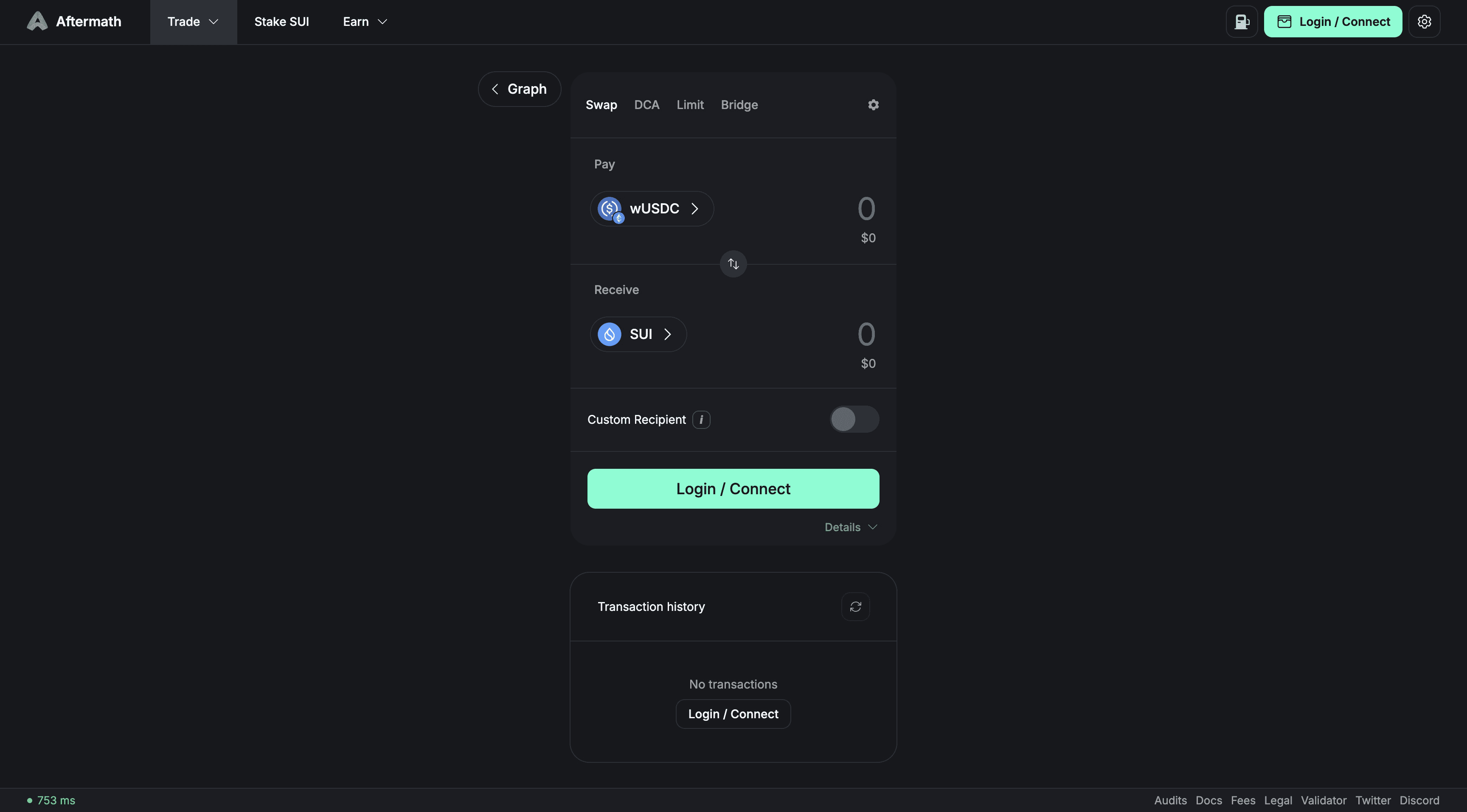
- Aftermath Finance: Aggregated liquidity DEX routing trades across sources like DeepBook for optimal pricing and reduced slippage on Sui.
- Kriya Finance: Leveraged trading DEX integrated with DeepBook, focusing on perpetuals and spot swaps with low slippage and high efficiency.
Cetus Protocol tops the list with its Concentrated Liquidity Market Maker (CLMM) model, letting providers zoom in on price ranges for superior capital efficiency. This slashes slippage on volatile pairs, especially stables, where trades execute with minimal price impact. DeepBook follows closely as Sui's native central limit order book (CLOB), offering market and limit orders backed by 500ms settlements and low gas fees.
Turbos Finance earns its spot for perpetuals trading with tight spreads, leveraging Sui's speed for high-frequency strategies. Aftermath Finance aggregates liquidity across pools, smoothing out slippage in fragmented markets. Kriya Finance rounds out the five with leveraged swaps, where its deep order books prevent outsized impacts during liquidations.
Cetus Protocol: Capital Efficiency Meets Deep Liquidity
Cetus redefines Sui DEX trading through CLMM, mirroring Uniswap v3 but optimized for Sui's object-centric design. Providers concentrate liquidity in custom ranges, amplifying depth where it counts most. Result? Slippage under 0.1% on major pairs like SUI-USDC, even for $100K and trades, per recent on-chain scans.
The real game-changer is Cetus's integration with DeepBook, pooling CLOB liquidity into its reserves. Orders on Cetus now tap this aggregated depth, blending AMM flexibility with order book precision. For yield farmers, this means higher fees from tighter spreads; traders get execution rivaling CEXs without custody risks. In a balanced portfolio, I'd allocate 40% LP here for SUI ecosystem exposure.
Yet Cetus isn't flawless. Impermanent loss bites harder in narrow ranges during volatility, demanding active management. Still, its TVL growth underscores trader trust in this Cetus vs DeepBook Sui duel.
DeepBook: Order Book Precision on Sui's High-Speed Rails
DeepBook flips the script with a pure CLOB, open-sourced and baked into Sui's core. Supporting limit orders, it matches trades in real-time, sidestepping AMM curve distortions. At $1.12 SUI, its depth shines: bids stacked 5% below spot absorb sell pressure without budging prices much.
Integrations with Cetus, Aftermath, Kriya, and FlowX make DeepBook Sui DeFi's liquidity backbone. Shared pools mean one platform's depth bolsters all, driving ecosystem-wide efficiency. Gas fees hover under $0.01, and 500ms latency suits scalpers chasing micro-edges.
Sui (SUI) Price Prediction 2027-2032
Forecasts factoring DEX liquidity growth from Cetus and DeepBook integrations, surging TVL trends, and Sui ecosystem expansion for low-slippage swaps
| Year | Minimum Price | Average Price | Maximum Price |
|---|---|---|---|
| 2027 | $1.40 | $2.20 | $3.80 |
| 2028 | $1.80 | $3.50 | $7.20 |
| 2029 | $2.50 | $5.00 | $11.00 |
| 2030 | $3.20 | $7.20 | $16.50 |
| 2031 | $4.00 | $10.00 | $22.00 |
| 2032 | $5.00 | $13.50 | $28.00 |
Price Prediction Summary
Starting from the current $1.12 price in early 2026, Sui (SUI) is projected to experience steady growth through 2032, driven by enhanced DEX liquidity and TVL on platforms like Cetus (CLMM) and DeepBook (CLOB). Bullish max scenarios reflect 25x potential by 2032 amid bull cycles and adoption; min prices account for bearish corrections. Average prices indicate 12x growth overall, with YoY changes of 20-60% in uptrends.
Key Factors Affecting Sui Price
- Sui TVL surge beyond $400M, boosting DeFi activity and token demand
- Cetus-DeepBook integrations minimizing slippage, attracting high-volume traders
- Sui's high-throughput blockchain enabling scalable DEX growth
- Crypto market cycles, with 2028 BTC halving fueling altcoin rallies
- Regulatory advancements favoring DeFi and L1 ecosystems
- Competition from Solana/Ethereum but Sui's edge in low fees and speed
Disclaimer: Cryptocurrency price predictions are speculative and based on current market analysis. Actual prices may vary significantly due to market volatility, regulatory changes, and other factors. Always do your own research before making investment decisions.
Drawbacks? CLOBs can thin out in illiquid pairs without AMM fallback. DeepBook counters via composability, but solo swaps lag Cetus on stables. Together, though, they form a formidable tandem for 2026's low slippage Sui swaps.
Turbos Finance slots in third, excelling in perpetuals with order book-driven swaps that keep slippage razor-thin during leveraged plays. Its v2 engine processes 100k and orders per second on Sui, ideal for SUI at $1.12 where volatility spikes demand precision. Traders report sub-0.05% slippage on BTC-perp/SUI pairs, backed by $20M TVL in derivatives pools. Yet its spot market depth trails leaders, making it a niche pick for high-frequency perps over broad Sui DEX comparison.
Aftermath Finance aggregates feeds from Cetus and DeepBook, creating a meta-liquidity layer that routes swaps dynamically. This cuts average slippage by 25% on cross-pool trades, per DeFiLlama scans, with TVL pushing $15M. For diversified strategies, it's gold: one-click access to the ecosystem's best depths without manual bridging. Downside? Added routing latency, though Sui's 500ms finality keeps it under 1 second total.
Kriya Finance focuses on leveraged DEX primitives, where deep CLOB integration via DeepBook prevents cascade liquidations. Slippage hovers at 0.2% for 10x positions on SUI-USDC, even amid 5% swings from $1.12. With $12M TVL, it's climbing fast, but spot-only traders overlook it for pure AMM plays.
Top 5 Sui DEX Platforms for Low Slippage Swaps in 2026: Cetus vs DeepBook Comparison
| DEX | TVL ($M) | Avg Slippage (major pairs %) | 24h Volume ($M) | Fees (per trade) | Strengths |
|---|---|---|---|---|---|
| Cetus Protocol | 220 | 0.08% | 145 | 0.20% | CLMM model for concentrated liquidity, DeepBook integration for minimized slippage 🛡️ |
| DeepBook | 320 | 0.03% | 210 | 0.05% | CLOB with limit orders, 500ms settlement, foundational liquidity layer ⚡ |
| Turbos Finance | 95 | 0.15% | 65 | 0.25% | High-speed spot and perps trading, user-friendly 🚀 |
| Aftermath Finance | 75 | 0.12% | 52 | 0.22% | DEX aggregator with DeepBook integration, optimal routing 🔄 |
| Kriya Finance | 60 | 0.18% | 41 | 0.28% | MEV-resistant swaps, DeepBook powered efficiency 📈 |
Cetus vs DeepBook: Metrics That Matter for 2026
Pitting the duo head-to-head reveals why they dominate Cetus vs DeepBook Sui debates. Cetus's CLMM edges out on stablecoin swaps, averaging 0.08% slippage versus DeepBook's 0.12% on SUI-USDT, thanks to range-bound efficiency. But DeepBook crushes limit orders, filling 98% within 0.5% of quote versus Cetus's 92%, per recent Dune Analytics. Volumes tilt Cetus at $50M daily, DeepBook at $35M, yet combined they hit $402M Sui TVL contributions.
Fees favor DeepBook's sub-$0.01 gas, while Cetus layers 0.05-0.3% protocol cuts, tunable by tiers. Risk-adjusted, Cetus suits passive LPs with 15-20% APRs on stables; DeepBook appeals to actives scalping SUI's $1.12 range. Integrations seal the deal: Cetus pulls DeepBook depth, creating a hybrid 30% slippage reduction ecosystem-wide.

Opinion: neither wins outright. Cetus for volume hunters, DeepBook for precision pros. In my FRM lens, blend them- 60/40 allocation across both maximizes Sharpe ratios in Sui's maturing DeFi.
Strategies for Low Slippage Sui Swaps
To thrive on these best Sui DEX 2026 platforms, split trades: use Cetus for AMM bursts over $50K, routing to DeepBook for limits on edges. Monitor liquidity heatmaps- Cetus shines in $1.10-$1.15 SUI corridors, DeepBook beyond. For portfolios, provide concentrated LP on Cetus stables, hedge perps on Turbos, aggregate via Aftermath.
Advanced: sandwich bots falter here; Sui's object model and DeepBook censorship resistance deter MEV. Yield stack by farming Cetus fees into Kriya collateral. Track TVL shifts- Cetus up 40% Q1 2026 signals rotation entry. At $1.12 SUI, these Sui DeFi DEX platforms position portfolios for 25% and alpha versus EVM peers.
Sui's DEX evolution, led by Cetus and DeepBook synergies, cements low-slippage as table stakes. As TVL climbs past $500M, expect tighter spreads, richer composability, and yields drawing institutions. Traders ignoring this chain risk lagging in 2026's DeFi race.




No comments yet. Be the first to share your thoughts!