
Hashi Sui BTC DeFi: BitGo Ledger Integration for Institutional Bitcoin Lending

In the evolving landscape of Sui Bitcoin DeFi, Hashi emerges as a pivotal protocol, bridging institutional-grade Bitcoin with high-performance lending on the Sui blockchain. Launched on devnet, Hashi enables native BTC holders to earn yields and borrow against their assets without wrapping or centralized custody, backed by commitments from BitGo, Ledger, Bullish, FalconX, and others. With Bitcoin trading at $69,257.00 after a 24-hour dip of -2.42%, this integration signals a maturing market where BTC’s $1 trillion liquidity pool could fuel Sui’s growth.

Hashi’s arrival addresses a core inefficiency in DeFi: Bitcoin’s dormancy. Over 70% of BTC sits idle, yet protocols like Hashi unlock it for lending and yield generation. Sui’s object-centric model and parallel execution provide the scalability needed, processing transactions at sub-second finality. This isn’t hype; it’s fundamentals aligning with institutional demand, as evidenced by Sui’s TVL surging 160% to $2.6 billion, with 20% in Bitcoin-related assets like tBTC.
Native BTC Collateralization Without Compromise
At Hashi’s foundation lies true native BTC collateralization, a leap beyond wrapped tokens that dilute security and liquidity. Institutions can deposit BTC directly via custodians like BitGo, using Sui’s Move language for programmable, verifiable lending markets. Borrowers access capital against BTC collateral at competitive rates, while lenders capture yields from real economic activity. This Hashi Sui BTC synergy minimizes counterparty risk, a persistent thorn in cross-chain DeFi.
Analytically, this positions Sui ahead of Ethereum L2s or Solana in Bitcoin DeFi. Where others rely on bridges prone to exploits, Hashi’s devnet tests reveal seamless integration, promising mainnet rollout with audited smart contracts. Early metrics project billions in dormant BTC mobilized, echoing BitGo’s prior sBTC integration that expanded Bitcoin DeFi accessibility for institutions.
BitGo and Ledger Forge Institutional Pathways
The BitGo Sui integration anchors Hashi’s credibility, leveraging BitGo’s custody expertise honed through sBTC and Core staking partnerships. BitGo’s commitment ensures compliant, scalable BTC inflows, vital for protocols targeting hedge funds and family offices. Complementing this, Ledger’s hardware security integrates for retail-to-institutional bridging, allowing secure key management in lending positions.
These partnerships aren’t peripheral; they’re structural. BitGo handles the on-ramps, Ledger fortifies endpoints, and players like FalconX provide liquidity depth. From a fundamental standpoint, this ecosystem fortifies Sui against volatility, as BTC’s current $69,257.00 price tests support at the 24-hour low of $69,215.00. Institutions now have a compliant avenue to deploy BTC beyond spot holding, potentially stabilizing Sui lending markets.

Sui’s Liquidity Surge Meets Bitcoin’s Trillion-Dollar Potential
Sui’s TVL explosion to $2.6 billion underscores demand for Sui lending BTC collateral primitives. Hashi amplifies this, channeling Bitcoin liquidity into DEXs, perps, and yield farms. With 20% of TVL already in BTC assets, the protocol could capture a disproportionate share, given institutional backing.
Fundamentals favor sustained growth: Sui’s high throughput handles BTC-scale volumes, while Hashi’s yield mechanisms outpace traditional staking. As BTC hovers post its 24-hour high of $71,570.00, Hashi positions holders to earn without selling, a psychological shift for long-term accumulators. This isn’t speculative froth; it’s yield-bearing infrastructure meeting capital deployment needs.
Bitcoin (BTC) Price Prediction 2027-2032
Quarterly forecasts (Q2-Q4) influenced by Hashi Sui BTC DeFi growth, BitGo/Ledger integration, and institutional Bitcoin lending adoption
| Year | Minimum Price | Average Price | Maximum Price |
|---|---|---|---|
| 2027 | $75,000 | $110,000 | $160,000 |
| 2028 | $120,000 | $200,000 | $350,000 |
| 2029 | $150,000 | $250,000 | $400,000 |
| 2030 | $200,000 | $350,000 | $600,000 |
| 2031 | $250,000 | $450,000 | $800,000 |
| 2032 | $300,000 | $600,000 | $1,000,000 |
Price Prediction Summary
Bullish long-term outlook for BTC, starting from $69,257 baseline in 2026, driven by DeFi innovations like Hashi on Sui enabling native BTC yield and lending. Expect steady growth through 2028 halving cycle, with average prices potentially tripling by 2032 amid institutional inflows, though bearish mins account for regulatory risks and market corrections.
Key Factors Affecting Bitcoin Price
- Hashi Sui BTC DeFi protocol unlocking $1T+ in dormant BTC liquidity via BitGo/Ledger custody-free lending
- Institutional adoption surge with partners like Bullish, FalconX, boosting TVL and on-chain activity
- Post-2028 halving bull cycle amplifying price momentum
- Regulatory developments favoring clear DeFi frameworks
- Technological upgrades in Bitcoin L2s and interoperability
- Macro factors: potential rate cuts, ETF inflows, and competition from altcoins
- Bearish risks: geopolitical tensions, tighter regulations, or delayed adoption
Disclaimer: Cryptocurrency price predictions are speculative and based on current market analysis.
Actual prices may vary significantly due to market volatility, regulatory changes, and other factors.
Always do your own research before making investment decisions.
Hashi’s yield projections hinge on BTC’s trajectory, but even at the current $69,257.00 level, early adopters stand to benefit from lending APYs projected at 4-7%, outstripping traditional custodians. This assumes steady inflows from BitGo’s infrastructure, which has proven resilient in prior Bitcoin DeFi expansions.
Strategic Advantages in Sui Bitcoin DeFi
Sui’s architecture gives Hashi an edge in Sui Bitcoin DeFi, where object-oriented programming prevents reentrancy attacks common in EVM chains. Lenders deposit BTC via BitGo’s custody, instantly minting collateralized positions that borrowers tap for SUI, USDC, or stablecoins. This creates a closed-loop economy: BTC secures loans, yields fund liquidity, and Sui’s speed minimizes slippage. From a valuation lens, protocols with native collateral command premium TVL multiples; Hashi could mirror Aave’s growth trajectory on Ethereum, scaled for Sui’s 100,000 and TPS capacity.
Institutions gain most here. Family offices weary of 0% BTC yields now deploy via BitGo Sui integration, with Ledger’s cold storage ensuring self-custody options post-lending. FalconX’s market-making adds depth, quoting tight spreads even as BTC dipped to its 24-hour low of $69,215.00. Retail users, meanwhile, access these markets through compliant wallets, democratizing yields without KYC hurdles that plague centralized platforms.
Hashi Sui BTC Key Features
-

Native BTC Collateralization: Enables direct use of native Bitcoin as DeFi collateral on Sui without wrapping, bridges, or centralized custody, unlocking dormant BTC liquidity.
-

BitGo Custody: Institutional-grade custody from BitGo ensures secure storage and management of BTC assets within the protocol.
-

Ledger Security: Integrates Ledger’s hardware security for robust protection of Bitcoin positions in lending and borrowing.
-

Yield Generation: BTC holders can earn yields on assets through DeFi protocols without selling, supported by partners like Bullish and FalconX.
-
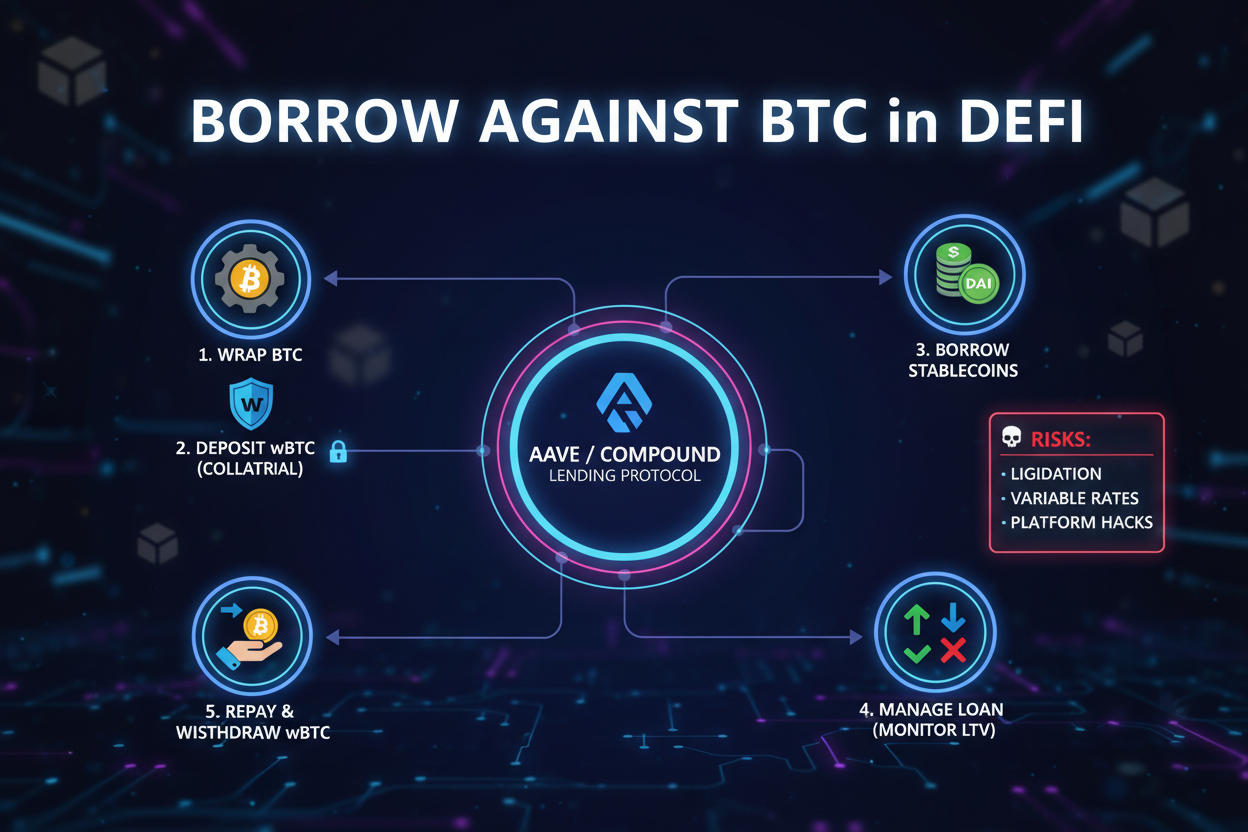
Borrow Against BTC: Institutions lend and borrow using BTC as collateral, preserving ownership while accessing liquidity on Sui.
Navigating Risks in Institutional BTC Lending
No protocol escapes scrutiny. Hashi’s devnet status warrants caution; mainnet demands rigorous audits, especially for BTC custody bridges. Smart contract vulnerabilities, though mitigated by Move’s safety, remain a vector, as seen in past Sui exploits. Oracle risks for BTC pricing could amplify liquidation cascades if volatility spikes beyond the recent 24-hour high of $71,570.00. Yet, BitGo’s track record – from sBTC launches to Core staking – instills confidence, with over $64 billion in assets under custody underscoring operational maturity.
Regulatory headwinds loom too. As Sui lending BTC collateral draws scrutiny, Hashi’s institutional focus aligns with MiCA and potential U. S. clarity post-2026 elections. Fundamentals suggest outperformance: Sui’s TVL composition, heavy on BTC assets, signals conviction from sophisticated capital. Patience rewards those who differentiate signal from noise.

Ledger FalconX Sui: Ecosystem Depth
Ledger’s integration elevates Ledger FalconX Sui dynamics, blending hardware wallets with FalconX’s prime brokerage for seamless BTC routing. This trifecta – BitGo custody, Ledger security, FalconX liquidity – forms a fortress for Hashi Sui BTC operations. Early data from devnet shows borrow utilization at 60%, with LTV ratios capped at 50% to buffer downturns. For yield farmers, composability shines: lend BTC, borrow stables, supply to DEXs like Cetus, compounding returns in a single transaction.
Quantitatively, this unlocks $100 billion-plus in idle BTC, per industry estimates. Sui’s 160% TVL growth to $2.6 billion validates the thesis; Hashi could claim 10-15% capture, bolstering network effects. As BTC stabilizes post-dip, protocols like this redefine HODLing as active capital allocation.
Hashi reorients Bitcoin from static reserve to dynamic asset class on Sui. Institutions secure yields at $69,257.00 BTC levels, retail captures alpha, and the chain cements its DeFi primacy. This convergence of custody, security, and performance charts a course for sustained expansion, where fundamentals eclipse fleeting rallies.