

Mastering Collateralized Borrowing on Navi Protocol Sui Step-by-Step
In the fast-evolving world of Sui DeFi, where Sui’s price holds steady at $0.9207 amid a modest 24-hour gain of and 0.0143%, Navi Protocol Sui emerges as a cornerstone for collateralized loans Sui. This decentralized platform empowers users to unlock liquidity without selling assets, a critical tool for Sui lending borrowing strategies that amplify yields while navigating volatility. As borrowing limits tighten in traditional finance, Navi’s permissionless model on the high-throughput Sui blockchain offers a compelling alternative for leveraged positions.

Navi Protocol distinguishes itself through isolation mechanisms that contain risks within specific pools, preventing cascade failures seen in less robust protocols. Users supply assets to earn interest while using them as collateral for borrows, with borrowing caps dictated by collateral value and real-time oracles. This setup supports Sui DeFi leverage without the counterparty risks of centralized lenders, though it demands vigilant monitoring of the Health Factor to sidestep liquidations.
Risks and Rewards Comparison: Health Factor Impacts and Liquidation Scenarios on Navi Protocol Sui
| Scenario | Supplied Collateral | Borrowed (USDC) | Health Factor | Rewards 🎯 | Risks ⚠️ | Liquidation Scenario 💀 |
|---|---|---|---|---|---|---|
| Conservative | 1000 SUI ($920.70) | $200 | 3.68 | • High safety margin • Earn supply APR on SUI • Borrow cheap for low-risk yields |
• Lower leverage gains • Opportunity cost of unused capacity |
Requires ~73% drop in SUI price (to $0.25) |
| Moderate | 1000 SUI ($920.70) | $400 | 1.84 | • Balanced leverage • Good yield potential • Comfortable buffer vs. volatility |
• Moderate exposure to price swings • Interest costs rise with utilization |
Requires ~46% drop in SUI price (to $0.50) |
| Aggressive | 1000 SUI ($920.70) | $600 | 1.23 | • High leverage for amplified yields • Advanced strategies (e.g., looping) |
• Sensitive to market dips • Higher variable rate risk |
Requires ~19% drop in SUI price (to $0.75) |
| High Risk | 1000 SUI ($920.70) | $700 | 1.05 | • Maximum borrowing power • Potential for outsized returns |
• Near-constant monitoring needed • Fast interest accrual |
Requires ~5% drop in SUI price (to $0.88) • Immediate liquidation risk |
Decoding the Health Factor in Navi Protocol Borrowing
The Health Factor serves as Navi’s risk barometer, calculating the ratio of collateral value to borrowed amounts adjusted for liquidation thresholds. A value above 1 signals safety; dipping below triggers auctions where liquidators repay debt to claim collateral at a discount. In current conditions, with SUI at $0.9207, conservative borrowers target Health Factors north of 2 to buffer price dips like the recent 24-hour low of $0.8995. This metric underscores why Navi Protocol guide emphasizes over-collateralization: it transforms idle assets into productive capital without undue exposure.
Isolation pools further enhance resilience. Unlike monolithic designs, losses in one asset class stay ring-fenced, a savvy engineering choice for Sui’s object-centric architecture. Borrowers can select stable or variable rates, with variables often cheaper but sensitive to utilization spikes. Fundamentals here favor patient allocators who pair high-quality collateral like SUI with conservative borrow ratios.
Sui (SUI) Price Prediction 2027-2032
Forecast from 2026 base price of $0.9207, driven by Sui DeFi growth including Navi Protocol collateralized borrowing
| Year | Minimum Price (USD) | Average Price (USD) | Maximum Price (USD) | YoY % Change (Avg) |
|---|---|---|---|---|
| 2027 | $0.80 | $1.42 | $2.50 | +54% |
| 2028 | $1.20 | $2.25 | $4.00 | +58% |
| 2029 | $1.80 | $3.50 | $6.50 | +56% |
| 2030 | $2.50 | $5.20 | $9.50 | +49% |
| 2031 | $3.50 | $7.50 | $13.50 | +44% |
| 2032 | $4.50 | $10.50 | $18.00 | +40% |
Price Prediction Summary
SUI is projected to grow significantly from its 2026 price of $0.9207, fueled by DeFi expansion on Sui like Navi Protocol. Average prices are expected to rise progressively to $10.50 by 2032, with bullish highs up to $18.00 and bearish lows around $4.50, reflecting market cycles, adoption, and ecosystem maturity.
Key Factors Affecting Sui Price
- DeFi ecosystem growth on Sui, boosted by Navi Protocol’s lending/borrowing features and TVL increases
- Sui blockchain scalability upgrades and technological advancements
- Crypto market cycles aligned with Bitcoin halvings and bull runs in 2028-2030
- Regulatory developments supporting DeFi and blockchain adoption
- Institutional inflows and macroeconomic recovery
- Competition from other L1s like Solana and potential market saturation risks
Disclaimer: Cryptocurrency price predictions are speculative and based on current market analysis.
Actual prices may vary significantly due to market volatility, regulatory changes, and other factors.
Always do your own research before making investment decisions.
Setting Up for Success: Wallet and App Essentials
Before diving into collateralized borrowing on Navi Protocol Sui, ensure your Sui-compatible wallet like Sui Wallet or Martian is funded and updated. Navi’s app at app. naviprotocol. io loads swiftly on Sui’s parallel execution, minimizing gas fees even during peaks. Connect via WalletConnect, approve permissions, and review your dashboard for real-time APRs and borrowable assets. This frictionless onboarding reflects Sui’s developer-friendly ethos, positioning Navi ahead in user experience.
Pro tip: Start small to familiarize with gas dynamics. Sui’s low fees, often under $0.01, make experimentation viable, but always simulate transactions in wallets to preview Health Factor impacts.
Step 1: Supplying Collateral Like a Pro
Navigate to the Supply section post-connection. Popular collaterals include SUI at $0.9207 and LSTs for compounded yields. Enter your deposit amount, scrutinize the APR, and projected Health Factor post-supply. Confirm via wallet; the transaction mints aNavi tokens representing your position, redeemable anytime with accrued interest.
Analytically, prioritize assets with low volatility and high loan-to-value (LTV) ratios, often 70-80% on Navi. Supplying SUI now leverages its 24-hour high of $0.9247 momentum, but diversify to mitigate single-asset risk. This step unlocks borrow power, setting the stage for targeted Sui DeFi leverage.
Once supplied, your collateral earns while enabling borrows up to safe limits. Monitor via the dashboard’s visuals, which plot Health Factor trajectories under price scenarios. This proactive stance separates sustainable yield farmers from the liquidated masses.
With collateral in place, borrowing unlocks the real leverage potential in Navi Protocol Sui. Conservative positions here mean borrowing 50-60% of your collateral value, preserving a Health Factor above 2 even if SUI dips to its recent low of $0.8995. This measured approach suits Sui lending borrowing practitioners who view volatility not as a threat, but as an opportunity for asymmetric returns.
Step 3: Vigilant Monitoring and Risk Mitigation
Your position now demands ongoing scrutiny. The dashboard’s Health Factor gauge, coupled with price oracles, forecasts liquidation risks under stress tests. If SUI climbs toward its 24-hour high of $0.9247, breathing room expands; conversely, repay incrementally or add collateral to fortify. Navi’s flash loan integration offers a twist for power users: collateral-free borrows repaid in-transaction for arbitrage, though this elevates complexity beyond basic collateralized loans Sui.
Isolation mechanisms prove their worth during volatility; a single pool’s distress won’t cascade. Opinion: Skip hype-driven leverage chasing 90% LTVs; sustainable strategies cap at 60%, blending borrow costs with supply yields for net positive carry. Tools like Navi’s SDK enable programmatic oversight, ideal for developers automating Health Factor adjustments.
Sui Technical Analysis Chart
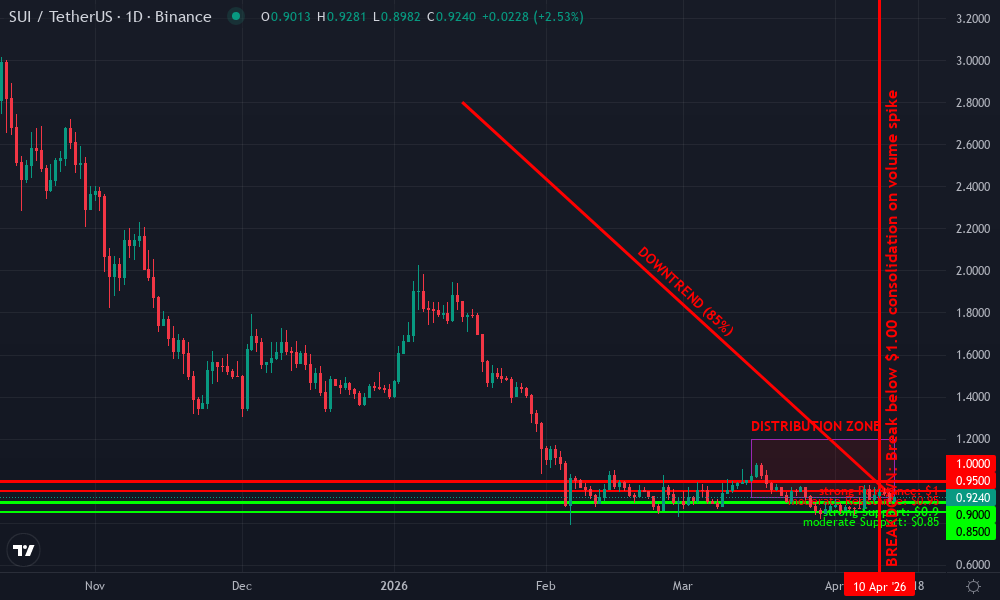
Analysis by Market Analyst | Symbol: BINANCE:SUIUSDT | Interval: 1D | Drawings: 7
Technical Analysis Summary
As a seasoned technical analyst with 5 years of experience focusing on balanced technical setups, I recommend the following drawing instructions to annotate this SUIUSDT 1D chart: 1. Use ‘trend_line’ to connect the major downtrend from the peak at approximately 2026-01-15 high near $2.80 to the recent low at 2026-04-13 around $0.90, highlighting the dominant bearish channel. 2. Add ‘horizontal_line’ at key support $0.9000 and resistance $0.9500 for clear S/R visualization. 3. Mark ‘rectangle’ for the recent consolidation zone between $0.9500-$1.0500 from 2026-03-01 to 2026-04-01. 4. Place ‘arrow_mark_down’ at the breakdown below $1.00 on 2026-04-05 signaling continued downside. 5. Use ‘long_position’ and ‘short_position’ icons near potential entry zones: long at $0.9050 support, short at $0.9350 resistance. 6. Add ‘text’ labels for volume analysis: ‘Declining volume on pullback’ near recent bars. 7. ‘callout’ for MACD bearish divergence hint if visible. 8. ‘vertical_line’ at 2026-04-13 for current session reference. These tools will crisply outline the bearish structure while spotting reversal potential.
Risk Assessment: medium
Analysis: Bearish structure with near-term support test; medium risk tolerance favors defined setups over aggressive trades
Market Analyst’s Recommendation: Monitor $0.90 support for long bias if holds with volume, otherwise prepare for further downside to $0.85; scale in shorts above $0.95 rejection.
Key Support & Resistance Levels
📈 Support Levels:
-
$0.9 – Recent swing low and psychological support near 24h low $0.8995
strong -
$0.85 – Next major support if breakdown occurs, prior consolidation base
moderate
📉 Resistance Levels:
-
$0.95 – Recent 24h high zone $0.9247 extension, overhead supply
moderate -
$1 – Key psychological and prior consolidation low-turned-resistance
strong
Trading Zones (medium risk tolerance)
🎯 Entry Zones:
-
$0.905 – Bounce from strong support $0.90 with volume confirmation for medium-risk long
medium risk -
$0.935 – Rejection at resistance for short entry in downtrend continuation
medium risk
🚪 Exit Zones:
-
$0.95 – First profit target on long or stop loss on short
💰 profit target -
$0.88 – Profit target on short to next support
💰 profit target -
$0.98 – Stop loss above resistance on long
🛡️ stop loss
Technical Indicators Analysis
📊 Volume Analysis:
Pattern: Declining volume on recent pullback after breakdown spike
Bearish drop on high volume confirmed trend, but low volume bounce suggests potential exhaustion
📈 MACD Analysis:
Signal: Bearish (assumed crossover below zero line based on momentum)
MACD likely showing continued downside momentum with histogram contracting slightly
Applied TradingView Drawing Utilities
This chart analysis utilizes the following professional drawing tools:
Disclaimer: This technical analysis by Market Analyst is for educational purposes only and should not be considered as financial advice.
Trading involves risk, and you should always do your own research before making investment decisions.
Past performance does not guarantee future results. The analysis reflects the author’s personal methodology and risk tolerance (medium).
Repayment and Position Wind-Down
Repaying restores flexibility. From the Borrowings dashboard, select the asset, input partial or full amounts, and execute. Accrued interest deducts automatically, with stable rates offering predictability. Full repayment burns your debt position, freeing collateral for withdrawal. In practice, cycle funds strategically: borrow, farm yields, repay, repeat, compounding gains while SUI stabilizes around $0.9207.
Advanced allocators layer liquid staking tokens as collateral, borrowing against stSUI for dual yields. Yet, this amplifies tail risks; my analysis favors simplicity for most, prioritizing Health Factor over maximal leverage. Navi’s permissionless design, bolstered by Sui’s scalability, positions it as a Navi Protocol guide essential for enduring Sui DeFi plays.
Real-world edge comes from blending Navi with Sui’s DEX ecosystem. Borrow USDC against SUI, swap for LSTs on Cetus, restake for amplified APRs, then repay seamlessly. This loop exemplifies Sui lending borrowing at its finest, where patience unlocks compounded returns amid market noise. Fundamentals persist: over-collateralize, monitor relentlessly, and let Sui’s efficiency do the heavy lifting.
Navi Protocol Sui redefines collateralized loans Sui through engineered resilience and user-centric tools. In a landscape of fleeting protocols, its isolation and oracle precision foster trust, enabling traders to harness Sui DeFi leverage with calculated confidence. Position accordingly, and thrive.