
What are Sui Move primitives
Sui Move primitives are the fundamental building blocks that power the Sui blockchain. Unlike traditional blockchains that rely on account-based systems, Sui uses an object-centric model. In this architecture, the primary unit of value is not an account balance, but a unique on-chain object. Every asset, whether it is a token, a piece of digital art, or a complex financial instrument, exists as a distinct object with its own global identifier.
This shift changes how developers think about state management. Instead of updating a ledger entry for a user's wallet, programs manipulate these objects directly. The Move programming language provides the safety guarantees needed to handle these objects securely. It ensures that assets cannot be duplicated, lost, or accessed by unauthorized parties. This object-centric approach allows for parallel transaction execution, meaning multiple operations can happen simultaneously without conflicting with one another.
The core primitives include objects, addresses, and abilities. Objects carry data and logic, addresses identify owners or creators, and abilities define how these objects can be used—whether they can be destroyed, copied, or stored in a specific way. Together, these elements form the foundation for DeFi applications on Sui, enabling faster, more flexible, and more secure financial interactions.
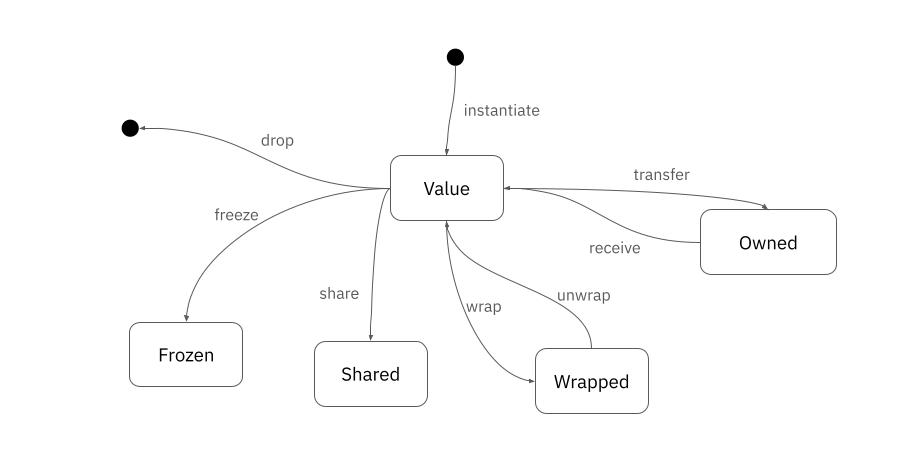
Objects versus accounts in DeFi
The fundamental difference between Sui and traditional EVM chains like Ethereum comes down to what constitutes the basic unit of value. In an account-centric model, assets are merely balances stored within a global ledger identified by an address. In Sui’s object-centric model, assets themselves are the primitives. Each object is a distinct, unique entity with its own ID, type, and storage, rather than a line item in a shared account state.
This architectural shift changes how data is stored and transferred. In Ethereum, transferring a token involves updating the sender’s balance and the recipient’s balance within the same global state. This sequential process creates bottlenecks. Sui treats every asset as an independent object that can be transferred or modified directly. This allows the network to process these operations in parallel, significantly increasing throughput.
Composability also behaves differently. On EVM chains, smart contracts interact with accounts by reading and writing to specific storage slots, which requires careful ordering to avoid race conditions. Sui’s objects can be passed directly between functions and contracts. This means that an asset can be used as a parameter in a transaction, enabling more flexible and composable DeFi interactions without the overhead of managing global account states.
| Aspect | Account-Centric (EVM) | Object-Centric (Sui) |
|---|---|---|
| Primary Primitive | Account (Address) | Object (Unique ID) |
| Asset Storage | Balance in global ledger | Independent object with own state |
| Transfer Mechanism | Update sender and recipient balances | Move object from sender to recipient |
| Parallelism | Sequential (global state lock) | Parallel (object-level isolation) |
| Composability | Function calls on account state | Direct object passing between contracts |
This distinction is critical for DeFi builders. By treating assets as first-class citizens that can be owned, transferred, and composed independently, Sui enables new patterns of financial interaction that are difficult or inefficient to replicate in account-centric systems.
How Move abilities enforce safety
Move treats every object as a distinct entity with strict ownership rules. This design eliminates entire classes of bugs common in other blockchains. By attaching abilities to types, the compiler prevents invalid operations before they reach the network.
The system relies on four core abilities: Store, Key, Drop, and Copy. Each ability defines how a type can be moved, stored, or discarded.
- Store: Allows an object to be stored in a global table. Without this, an object cannot persist on-chain.
- Key: Marks an object as uniquely identifiable by its ID. This enables direct addressing and is essential for NFTs and fungible tokens.
- Drop: Permits an object to be destroyed. If a type lacks
Drop, it cannot be discarded, leading to resource leaks. - Copy: Allows an object to be duplicated. Only simple types like integers or booleans have this ability. Complex objects like tokens do not.
This structure prevents double-spending by design. A token with Key and Store but without Copy can only exist in one place at a time. You cannot clone it. You cannot lose it accidentally because it lacks Drop if it’s meant to be permanent.
Think of these abilities as a type’s permission slip. The compiler checks every transaction against these rules. If a script tries to duplicate a non-copyable token, it fails at compile time. This shifts security from runtime checks to static guarantees.
The result is a system where common exploits like reentrancy or accidental duplication are impossible by construction. Developers write less defensive code because the language enforces the invariants.
Designing for parallel execution
Sui Move primitives shift the execution model from account-based to object-centric. In traditional blockchains, transactions often compete for access to shared account states, creating bottlenecks. Sui solves this by treating every asset and smart contract as a unique object with a distinct ID.
This architecture enables parallel transaction processing. When transactions target different objects, the Sui Move runtime can execute them simultaneously rather than sequentially. This is not a theoretical improvement; it is the direct result of how objects are referenced and locked. If two transactions interact with the same object, they are serialized. If they interact with different objects, they run in parallel.
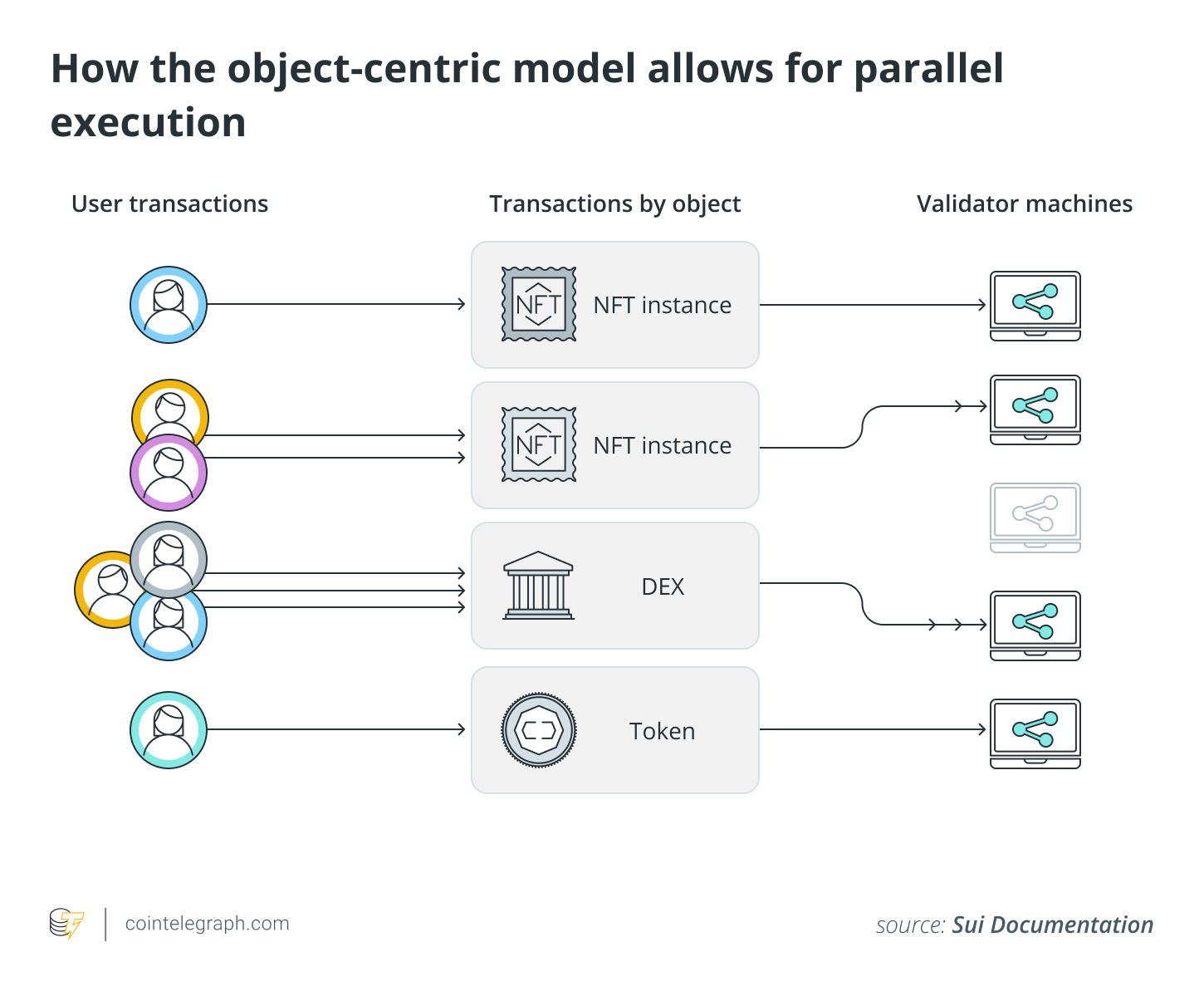
For DeFi protocols, this means higher throughput without sacrificing security. Liquidity pools, lending markets, and NFT marketplaces can process user actions—swaps, borrows, or transfers—much faster than on legacy EVM chains. The system scales with hardware, allowing more cores to handle more concurrent object interactions.
This design also simplifies composability. Because objects are first-class citizens, protocols can interact with each other’s assets directly. A lending protocol can lock an NFT object as collateral, while a marketplace can list that same object, all within the same block. The Sui Move language ensures these interactions remain safe and atomic, preventing race conditions that often plague parallel systems.
Common Sui Move patterns
Sui Move primitives are not abstract theory; they are the building blocks for DeFi applications like staking and lending. By treating assets as objects with unique IDs and capabilities, developers can construct protocols that are both secure and composable.
Lending Pools
In lending contexts, Sui Move primitives allow collateral to be locked as an object while interest-bearing tokens are minted. This ensures that the underlying asset remains traceable and cannot be double-spent. The object model simplifies the accounting logic, as the state of the loan is tied directly to the collateral object's lifecycle.
Staking Mechanisms
Staking protocols leverage the Coin<T> type to manage validator stakes. When a user stakes SUI, the protocol creates a new staking object that represents their share. Rewards are distributed by updating the value of these objects, ensuring that the total supply remains consistent without complex global state checks. This pattern reduces gas costs and execution time.
Frequently asked: what to check next
What is Move on SUI?
Move is the smart contract programming language powering the Sui network. Designed for safety and efficiency, it uses specific Sui Move primitives to manage resources as first-class citizens. This approach ensures that assets cannot be accidentally duplicated or lost, making it a robust foundation for complex DeFi logic.
Does SUI have smart contracts?
Yes, Sui relies entirely on Move smart contracts to execute its logic. Unlike EVM chains that use Solidity, Sui’s Move language allows for parallel transaction processing. This architecture enables the network to handle high throughput while maintaining strict security guarantees for digital assets.
Who are the key players behind SUI?
The Sui network was created by Mysten Labs, a team of engineers who previously worked on the Diem project at Meta. The technology is open-source, allowing developers to build on the protocol while the core team maintains the foundational infrastructure and reference implementations.
How does SUI compare to other blockchains?
Sui distinguishes itself through an object-centric model rather than an account-centric one. This allows for parallel execution of transactions that touch different objects, offering higher scalability and lower latency compared to traditional sequential blockchains. It is particularly suited for applications requiring high speed and complex asset interactions.
No comments yet. Be the first to share your thoughts!