
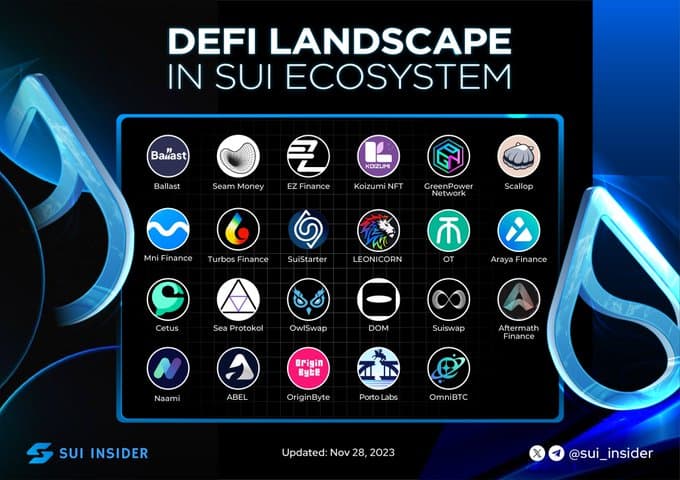
Sui's Move-based architecture
Sui’s architecture is built on the Move programming language, a shift from the traditional EVM model that defines how the blockchain handles data and execution. Instead of a single global state, Sui treats every digital asset as an independent object. This object-centric model allows the network to process transactions in parallel, significantly increasing throughput and reducing latency.
In traditional EVM chains, transactions often compete for the same global state, creating bottlenecks. Sui’s design lets the validator nodes execute transactions simultaneously if they touch different objects. This parallelism is not just a theoretical advantage; it is the foundation for the high-performance DeFi primitives emerging in 2026. Composability on Sui is tighter and more efficient, enabling complex financial instruments that would be prohibitively expensive on slower networks.
The technical foundation directly impacts user experience and developer flexibility. Smart contracts on Sui can manage ownership and transfer logic with greater precision, reducing the attack surface for common vulnerabilities. This security and speed combination is what distinguishes Sui’s ecosystem as it scales.
DeepBook V3 and margin trading
Sui’s DeepBook V3 upgrade marks a structural pivot for the network, introducing a native limit order book alongside its existing automated market maker (AMM) infrastructure. This hybrid model allows traders to execute precise limit orders and utilize margin trading, features that were previously absent from the core protocol. By offering these traditional finance primitives, Sui is positioning itself to capture institutional liquidity that requires tighter spreads and deeper depth than standard AMMs can provide.
The introduction of margin trading is particularly significant for attracting professional market makers. It enables leveraged positions directly on-chain, reducing the reliance on external bridges or centralized exchanges for capital efficiency. Aslan Tashtanov, DeFi Tech Lead Manager at Mysten Labs, has highlighted how this evolution transforms DeepBook from a simple liquidity aggregator into a comprehensive trading venue capable of supporting complex strategies.
This shift is reflected in the broader momentum of the Sui ecosystem. With total value locked rising and investor confidence renewing in early 2026, the network is leveraging these technical upgrades to support higher trading volumes. The combination of native order book capabilities and margin features creates a more robust environment for both retail and institutional participants, setting the stage for deeper market integration.

Top yield farming opportunities
The Sui DeFi landscape in 2026 has matured from experimental liquidity pools into a structured market of distinct yield strategies. Protocols now compete on risk-adjusted returns rather than raw APY, offering everything from stablecoin arbitrage to volatile asset liquidity provision. Choosing the right strategy depends on your tolerance for impermanent loss and your desire for active management.
The following comparison highlights the leading protocols by total value locked (TVL) and typical risk profiles. These metrics reflect the current state of the Sui ecosystem, where high-throughput execution allows for lower fees and faster settlement times compared to legacy Layer 1s.
| Protocol | Primary Strategy | Risk Profile | Est. TVL |
|---|---|---|---|
| Cetus | Concentrated Liquidity (CLMM) | Medium | $200M - $300M |
| Scallop | Lending & Borrowing | Low-Medium | $100M - $150M |
| SuiFi | Stablecoin Yield Aggregator | Low | $50M - $80M |
| Thala | Liquid Staking & AMM | Medium | $150M - $250M |
| Navi | Multi-Chain Lending | Low | $80M - $120M |
Concentrated Liquidity (CLMM) protocols like Cetus dominate trading volume. By allowing liquidity providers to allocate capital within specific price ranges, these platforms offer higher capital efficiency. However, this comes with the risk of positions going "out of range," requiring active rebalancing. This strategy suits traders who can monitor positions regularly.
Lending and Borrowing platforms such as Scallop and Navi provide a more passive yield experience. Users deposit assets to earn interest from borrowers, with risk primarily tied to protocol solvency and collateral liquidation mechanisms. These platforms generally offer lower but more stable returns, making them suitable for conservative allocation.
Liquid Staking and Aggregators represent the emerging core of Sui's yield infrastructure. Thala's liquid staking model allows users to earn staking rewards while maintaining liquidity, while aggregators like SuiFi automatically route deposits to the highest-yielding lending markets. These strategies minimize manual effort while capturing the base yield of the Sui network.
Ecosystem adoption trends
The 2026 thesis for Sui DeFi relies on more than just theoretical yield primitives; it demands visible network activity. Adoption metrics serve as the primary validation for this growth, bridging the gap between code deployment and real-world utility. Two distinct signals dominate this landscape: the velocity of developer capital through hackathons and the accumulation of total value locked (TVL) within the protocol.
Developer velocity and Overflow 2026
Developer activity is the leading indicator of long-term ecosystem health. The Overflow 2026 hackathon, hosted officially by the Sui Foundation, functions as a concentrated engine for this growth. By organizing global online tracks for builders, the event channels speculative interest into tangible project development.
This is not merely a contest for prize money; it is a funnel for talent. Participants build on Sui’s Move-based infrastructure, creating the foundational dApps that attract retail and institutional liquidity. The sheer volume of submissions during Overflow 2026 signals that builders view Sui as a primary deployment target for 2026, rather than a secondary testing ground.
TVL accumulation and market sentiment
Total Value Locked provides the economic gravity necessary to sustain DeFi yields. As developers deploy from Overflow and other initiatives, they bring capital with them. This inflow drives TVL growth, which in turn stabilizes yields and attracts passive investors seeking returns.
Market sentiment reflects this underlying strength. Live price data for SUI shows bullish momentum in early 2026, supported by rising TVL and renewed investor confidence. While short-term volatility persists, the correlation between developer output and capital inflow suggests a maturing asset class.
The validation loop
These metrics form a self-reinforcing loop. Strong developer activity leads to better dApps, which attract more TVL. Higher TVL improves yield competitiveness, which draws more users. This cycle validates the 2026 thesis by proving that Sui’s technical advantages translate into economic reality. Without this dual proof of developer engagement and capital accumulation, DeFi primitives remain theoretical exercises rather than viable financial infrastructure.
2026 price outlook and analyst targets
SUI has established itself as a notable Layer 1 asset, driven by strong funding and a reputation for speed. By early 2026, the token showed strong bullish momentum, supported by rising total value locked (TVL) and expanding ecosystem growth. This renewed investor confidence has shifted market focus toward medium-term price potential rather than immediate short-term fluctuations.
Analyst projections suggest that if SUI breaks through key resistance levels, the token could target the $3–$5 range in 2026. This forecast is grounded in the fundamental drivers of the network, including increased developer activity and institutional interest. While some long-term models extend potential to $15–$18 by 2030, the immediate 2026 window remains the primary focus for traders evaluating entry points.
Live market data
The following widget provides real-time price data for SUI. Static price targets should be viewed as directional indicators rather than guaranteed outcomes, as crypto markets remain volatile.
Technical perspective
Understanding the current technical setup helps contextualize the $3–$5 target. Breaking above recent resistance zones is the critical threshold for validating the bullish outlook.
No comments yet. Be the first to share your thoughts!