
Sui defi primitives limits to account for
Sui DeFi primitives are the foundational building blocks that allow developers to construct decentralized financial applications. Unlike older blockchains that rely on monolithic smart contracts, Sui uses an object-centric model. This means assets like tokens or NFTs are treated as distinct objects with their own unique IDs and ownership rules. This structure enables parallel processing, allowing multiple transactions to happen simultaneously without clogging the network.
The core primitives include DeepBook, a decentralized exchange protocol that provides shared liquidity, and Move, the programming language that ensures safety. DeepBook allows builders to create spot and margin trading products without managing order books manually. Move’s type system prevents common vulnerabilities like reentrancy attacks, which have plagued other ecosystems. These tools give developers the flexibility to innovate while maintaining security.
For users, this translates to faster transaction finality and lower costs. The network can handle thousands of transactions per second, making it suitable for high-frequency trading and complex yield strategies. However, the ecosystem is still maturing. Liquidity is fragmented across various protocols, and users must carefully evaluate each platform’s smart contract audits and tokenomics. Understanding these primitives is essential for navigating the Sui DeFi landscape safely and effectively.
Sui defi primitives: comparing choices that change the plan
Choosing the right primitive on Sui requires balancing liquidity depth against capital efficiency. Unlike monolithic chains that force a single model, Sui’s architecture allows builders to select the best fit for their specific use case. This section breaks down the concrete tradeoffs between Sui’s core DeFi components so you can evaluate which fits your strategy.
DeepBook vs. AMMs
DeepBook serves as Sui’s on-chain order book, offering professional-grade trading with shared liquidity. It allows for precise price discovery and margin trading without the slippage common in automated market makers (AMMs). However, it requires active liquidity provision from market makers, which can lead to fragmentation if not managed well.
In contrast, AMMs like Scallop or Cetus provide instant liquidity with no need for counterparties. They are easier for retail users to interact with but suffer from impermanent loss and higher slippage on large orders. The choice depends on whether you prioritize execution quality (DeepBook) or ease of access (AMMs).
Lending vs. Liquid Staking
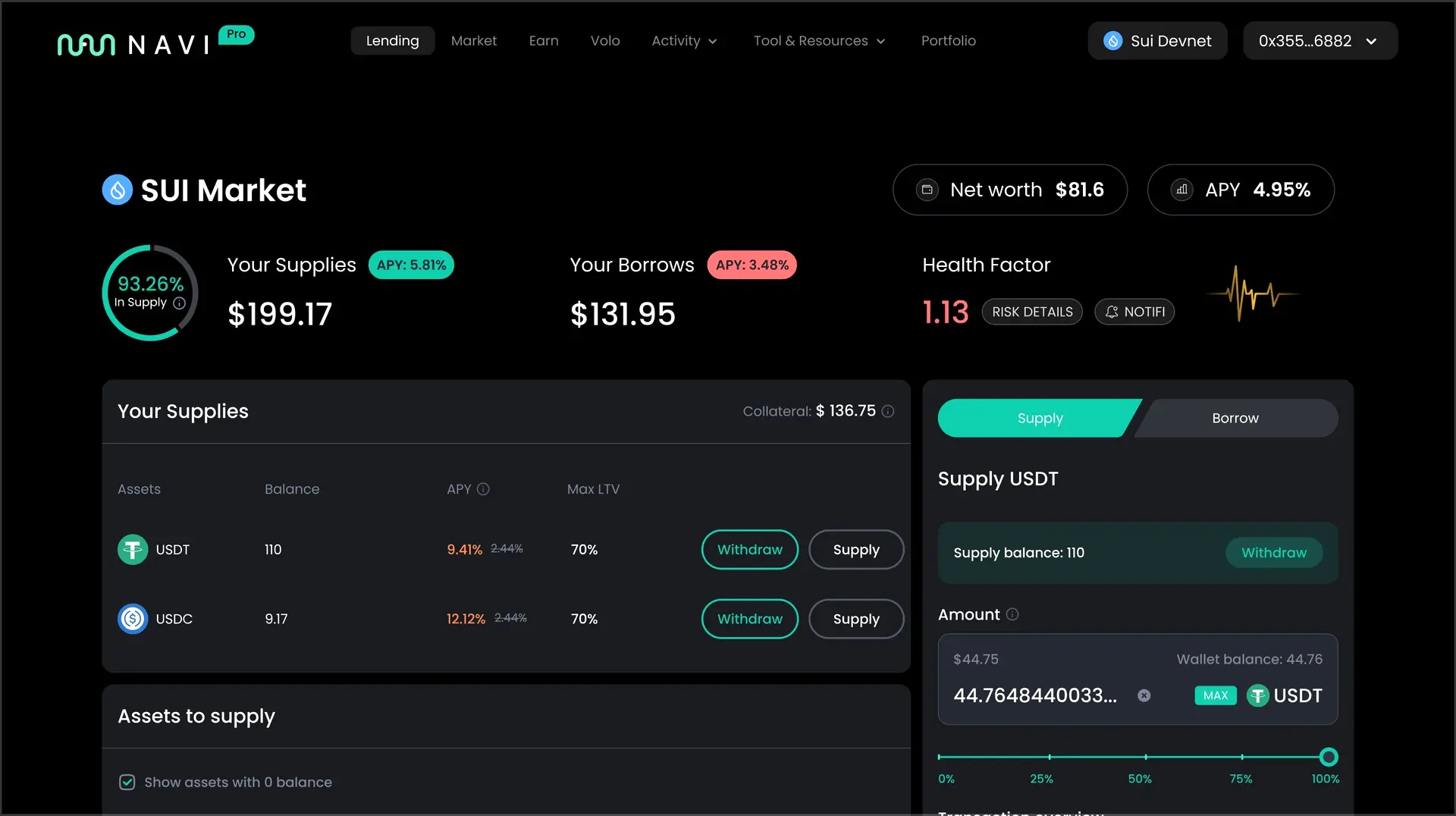
Lending protocols on Sui, such as Scallop, allow users to earn yield by supplying assets. The tradeoff here is risk: while yields are often higher than traditional finance, you are exposed to smart contract risk and collateral liquidation during market volatility.
Liquid staking derivatives (LSDs) like Scallop’s sSui or other providers offer a different risk profile. You stake native SUI to secure the network and receive a tokenized receipt that can be used elsewhere. This provides double-dipping opportunities but introduces complexity and potential de-pegging risks during network stress.
Cross-Chain Bridges vs. Native Swaps
Native Sui swaps are fast and cheap, leveraging the Move language’s safety features. However, they are limited to assets already on the Sui network. For exposure to external ecosystems, you must use cross-chain bridges.
Bridges introduce significant counterparty risk and latency. While they unlock access to a broader range of assets, they are the most common vector for exploits in DeFi. Native swaps are safer and cheaper, but bridges are necessary for diversification. Always verify bridge security audits before transferring large values.
| Primitive | Strength | Weakness | Best For |
|---|---|---|---|
| DeepBook | Low slippage, margin support | Fragmented liquidity | Active traders |
| AMMs | Instant liquidity, simple UX | Impermanent loss | Retail users |
| Lending | High yield potential | Liquidation risk | Yield seekers |
| Liquid Staking | Capital efficiency | Complexity, de-peg risk | Long-term holders |
| Cross-Chain Bridges | Asset diversity | Security risk, latency | Diversification |
Choose the next step
Building on the Sui Ecosystem Playbook requires moving from theory to execution. The architecture of Sui, with its Move-based smart contracts and object-centric data model, offers distinct advantages for DeFi primitives like DeepBook and lending protocols. However, selecting the right tools and strategies depends on your specific goals: maximizing yield, providing liquidity, or building trading infrastructure.
To navigate this landscape effectively, follow this decision framework. It breaks down the process into actionable steps, helping you identify the most suitable DeFi primitives and products for your needs.
Before engaging with any protocol, define your primary objective. Are you seeking stable yields through lending, or are you willing to provide liquidity for higher returns and impermanent loss risks? Sui’s high throughput allows for complex strategies, but higher complexity often correlates with higher smart contract risk. Start by categorizing your goals into conservative (lending), moderate (liquidity provision), or aggressive (leveraged trading via DeepBook Margin).
Sui’s ecosystem is built on specific primitives that serve different functions. For lending, look for protocols that offer overcollateralized loans. For trading, DeepBook provides concentrated liquidity and margin capabilities. Understand the mechanics of each: lending protocols offer passive income, while decentralized exchanges (DEXs) require active management. Choose the primitive that aligns with your assessed risk tolerance from the previous step.
Security is paramount in DeFi. Check the total value locked (TVL) as a proxy for community trust, but prioritize security audits. Sui-based protocols should have undergone rigorous testing, given the unique Move language. Look for audit reports from reputable firms and monitor community sentiment on official Sui channels. Avoid protocols with unaudited code or suspiciously low TVL relative to their claimed yields.
Once you’ve selected a primitive and verified its security, use the appropriate tools to execute. This might involve connecting a compatible wallet, interacting with a DApp interface, or utilizing SDKs if you are a builder. Ensure you are using the latest versions of software and have verified the contract addresses to avoid phishing scams. Start with small amounts to test the workflow before committing significant capital.


As an Amazon Associate, we may earn from qualifying purchases.
Spotting Weak DeFi Primitives on Sui
Not every protocol on Sui offers genuine yield. Many projects rely on aggressive token emissions rather than sustainable revenue from trading fees or lending interest. This creates a fragile foundation that can collapse when incentives dry up.
DeepBook stands out as a robust exception. Its Spot and Margin primitives provide shared liquidity and built-in leverage, allowing builders to launch trading products without constructing complex order books from scratch. This structural advantage supports real volume rather than speculative hype.
Beware of platforms promising high APY with no clear fee structure. If a protocol cannot explain how it generates revenue beyond token inflation, it is likely a weak option. Stick to protocols with transparent fee models and proven liquidity depth.
Sui defi primitives: what to check next
Before committing capital to the Sui ecosystem, it helps to distinguish between the network’s infrastructure and the specific financial instruments built on top of it. The following answers address the most common practical objections and technical clarifications for builders and liquidity providers.
Understanding these distinctions prevents confusion between network governance and specific yield-generating opportunities. Always verify the smart contract audits of individual protocols before depositing funds, as the underlying primitives are secure, but the implementations vary in risk.
No comments yet. Be the first to share your thoughts!