
Why Sui DeFi Primitives 2026 Matter
Sui’s architecture represents a fundamental shift in how decentralized finance handles assets. Unlike Ethereum and other EVM-compatible chains that rely on account-based models, Sui uses an object-centric approach. This distinction is not just academic; it changes how liquidity moves and how users interact with protocols. In 2026, this architectural advantage translates into tangible improvements in speed, parallelization, and capital efficiency.
The core primitive on Sui is the object. Every asset—whether a token, an NFT, or a liquidity position—is an independent object with its own unique ID and ownership rules. This structure allows multiple transactions involving different objects to happen simultaneously without clogging the network. For DeFi protocols, this means they can process trades, swaps, and liquidity additions in parallel, reducing latency and improving the user experience significantly compared to sequential EVM chains.
Sui’s object-centric model acts like a modern warehouse with individual tracking for every item, rather than a single ledger where everything is mixed together. This allows for precise, parallel management of assets without the bottlenecks of shared state.
This shift enables more complex DeFi strategies. Protocols can now offer features like concentrated liquidity with lower overhead and more dynamic risk management. The ability to treat assets as distinct objects allows for finer-grained control over liquidity pools, enabling protocols to optimize capital usage in ways that were previously too computationally expensive on other chains.
As we look at the DeFi landscape in 2026, the protocols built on Sui are leveraging these primitives to create more efficient markets. The focus is no longer just on being faster; it’s about enabling new financial instruments and user interactions that were previously impractical. This architectural foundation is why Sui is becoming a high-conviction area for DeFi innovation, offering a distinct alternative to the established EVM ecosystem.
DeepBook: The Core Liquidity Engine
DeepBook serves as the foundational liquidity layer for the Sui network, operating differently from the automated market makers (AMMs) found on most other blockchains. Instead of relying on a single, static pool for every trade, DeepBook acts as a central limit order book (CLOB) infrastructure that allows protocols to create their own customized liquidity pools. This architecture is critical for 2026’s DeFi landscape, where capital efficiency and privacy are paramount.
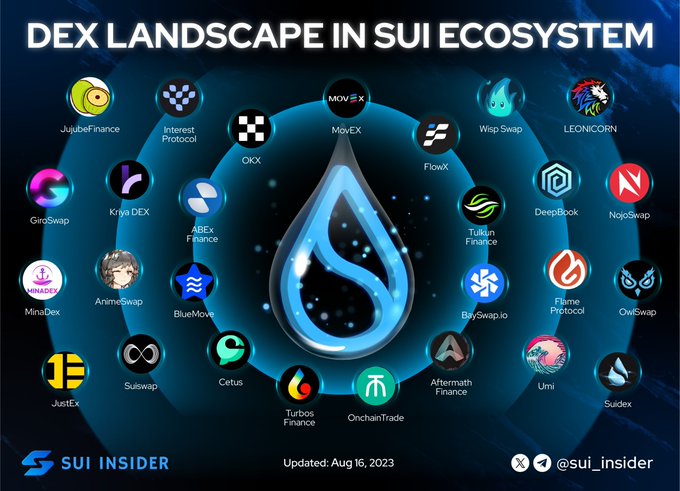
The system uses concentrated liquidity, meaning liquidity providers can allocate capital to specific price ranges rather than spreading it across an infinite curve. This approach mirrors traditional finance order books but on-chain. By allowing protocols like Scallop, Cetus, and Turbos to build their own pools on top of DeepBook, Sui enables specialized trading experiences. Each protocol can tune parameters such as fee structures and slippage tolerance to match its user base.
DeepBook also supports private transactions, a feature that has become essential for protecting traders from front-running and MEV (Maximal Extractable Value) attacks. In 2026, as institutional players enter the space, the ability to execute large trades without exposing intentions to the public mempool is a standard requirement. DeepBook’s infrastructure ensures that liquidity remains deep and prices remain stable even during high-volume periods.
To understand how DeepBook’s model compares to traditional AMMs, consider the following breakdown of their core mechanics.
| Feature | DeepBook (CLOB) | Traditional AMM |
|---|---|---|
| Liquidity Allocation | Concentrated (specific price ranges) | Uniform (entire price curve) |
| Capital Efficiency | High (focused liquidity) | Low (dispersed liquidity) |
| Price Discovery | Order book driven | Algorithmic curve driven |
| MEV Protection | Built-in private transactions | Vulnerable to front-running |
| Protocol Customization | High (per-pool parameters) | Low (standardized pools) |
Top Yield Strategies Using Sui Primitives
The 2026 Sui DeFi landscape has shifted from simple liquidity provision to sophisticated, composable yield generation. Builders now leverage the Move language’s object model to create primitives that reduce capital inefficiency and mitigate the risks inherent in earlier blockchain eras. For yield seekers, this means moving beyond basic staking into strategies that utilize private transactions and concentrated liquidity.
Private Lending and Borrowing
The most significant shift in Sui’s lending markets is the integration of private transactions. Protocols built on DeepBook now allow users to execute loans and borrowings without broadcasting trade details to the public mempool. This privacy layer prevents front-running and allows large institutional players to deploy capital without signaling their intent to the broader market.
This capability transforms lending from a transparent, often volatile, public market into a more stable utility. Users can lock assets as collateral and borrow against them with predictable rates, insulated from the sudden liquidity crunches that plague public order books. The focus here is on utility and stability rather than speculative arbitrage.
Prediction Markets
Prediction markets have emerged as a high-yield primitive, with DeepBook Predict leading the charge. Unlike traditional betting platforms, these markets are composable, meaning prediction outcomes can be used as collateral for other DeFi actions. This creates a closed-loop economy where yield from prediction trading can be immediately recycled into lending positions.
The mechanism relies on real-world data feeds, such as those from Pyth Network, to settle markets accurately. For users, this offers a way to earn yield from market volatility without holding the underlying volatile assets directly. It is a distinct strategy from staking, offering returns based on information accuracy rather than network security.
Concentrated Liquidity Staking
Standard liquidity provision often suffers from capital inefficiency, where funds sit idle outside the current price range. Sui’s concentrated liquidity protocols allow providers to allocate capital within specific price bands. This approach dramatically increases capital efficiency, meaning smaller amounts of capital can generate the same yield as much larger amounts in traditional models.
This strategy requires active management but offers superior returns for those willing to monitor price ranges. It is particularly effective in Sui’s high-throughput environment, where rebalancing can happen with minimal gas costs. The result is a yield strategy that feels more like active trading than passive holding.
Best DeFi Protocols on Sui 2026
The Sui DeFi landscape has matured significantly, shifting from experimental protocols to established platforms that prioritize capital efficiency and privacy. For users looking to engage with the ecosystem in 2026, the focus is on protocols that leverage Sui’s Move language for secure, parallelized transactions.
Cetus Protocol
Cetus remains the dominant decentralized exchange (DEX) on Sui, offering concentrated liquidity that allows traders to execute large orders with minimal slippage. Its intuitive interface makes it the go-to destination for swapping tokens and providing liquidity across major pairs. The protocol’s deep liquidity pools ensure that users can enter and exit positions efficiently, even during periods of high market volatility.
Scry Protocol
Scry Protocol has emerged as a leading oracle solution, providing real-time price data essential for lending and derivatives platforms on Sui. By delivering accurate and tamper-proof price feeds, Scry enables other DeFi applications to function securely without relying on centralized data sources. Its integration with multiple lending protocols ensures that collateral values are updated instantly, reducing the risk of liquidation errors.
SuiVela
SuiVela focuses on yield optimization, automating the movement of assets across various lending and staking protocols to maximize returns. This active management strategy helps users capture the best available yields without the need to constantly monitor and rebalance their portfolios. The platform’s smart contracts are designed to minimize gas costs and transaction failures, making yield farming more accessible to everyday users.
MystenX
MystenX serves as a foundational infrastructure layer, offering tools for developers to build and deploy DeFi applications on Sui. Its comprehensive SDK and documentation reduce the barrier to entry for new projects, fostering a diverse ecosystem of innovative financial products. By providing robust backend services, MystenX allows frontend developers to focus on user experience and product design.


As an Amazon Associate, we may earn from qualifying purchases.
Risks and security considerations
Every protocol on Sui carries smart contract risk. The Move language reduces common vector attacks, but logic errors in concentrated liquidity pools or lending markets still exist. Before depositing into any DeFi primitive, verify the audit status of the specific contract and understand the withdrawal mechanics. Newer protocols on the chain have shorter track records, meaning historical data on exploit frequency is limited.
Market volatility remains a primary threat to yield strategies. SUI has experienced significant price swings, dropping roughly 68% from its levels in mid-2025 to around $1.29 in May 2026. High volatility can trigger liquidations in leveraged positions or erode the real value of yield earned in stablecoins. Always model your position size against potential downside scenarios rather than optimistic APY projections.
The 2026 introduction of private transactions as a protocol primitive adds another layer of consideration. While these features protect user privacy, they can complicate due diligence for new users trying to verify the legitimacy of a protocol before depositing funds. Always cross-reference contract addresses with official sources and remain cautious of impersonator contracts that may exploit the opacity of private transaction flows.
Frequently asked: what to check next
What is the DeFi protocol on Sui?
Sui-based decentralized exchanges utilize concentrated liquidity protocols and concentrated liquidity market makers. These designs enhance capital efficiency and provide deep liquidity, enabling users to execute large trades with minimal slippage. The underlying Sui primitives facilitate this efficient liquidity sharing, allowing new DeFi products to flourish without the bottlenecks seen on older chains.
What are the risks of investing in Sui?
Like all other crypto assets, there are general risks to investing in SUI. These include short history risk, volatility risk, liquidity risk, demand risk, forking risk, cryptography risk, regulatory risk, concentration risk, electronic trading risk, and cyber security risk. Investors should weigh these factors carefully, especially given the rapid evolution of the ecosystem in 2026.
Who created the Sui blockchain?
Sui is developed by Mysten Labs, a company founded by former Meta (Facebook) engineers who previously worked on the Diem blockchain and the Move programming language. Key members of the Sui team include Adeniyi Abiodun, Evan Cheng, George Danezis, Kostas Chalkias, and Sam Blackshear. Their background in scalable systems informs the protocol's performance-focused architecture.
No comments yet. Be the first to share your thoughts!