
Why Sui DeFi 2026 matters now
Sui is positioning itself as the high-performance layer for a new global economy, moving beyond simple transaction throughput to offer a full-stack modular solution. For DeFi builders in 2026, the primary draw is not just speed, but the ability to handle complex financial primitives without the congestion that plagues earlier-generation chains. The network has matured into a robust environment where capital efficiency meets institutional-grade safety.
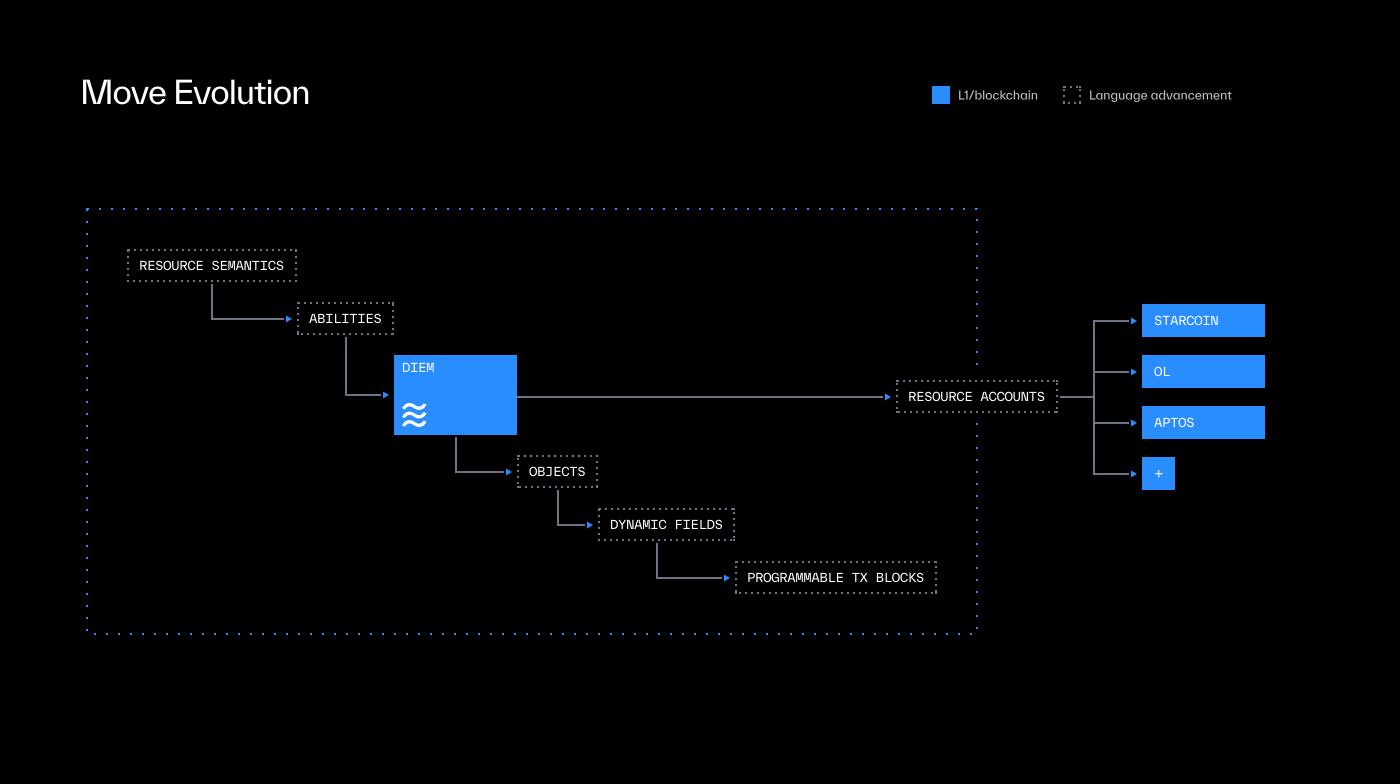
The foundation of this value proposition is the Move programming language. Unlike traditional smart contract languages, Move enforces strict ownership rules at the compiler level, preventing common vulnerabilities like reentrancy attacks and double-spending before code ever reaches the mainnet. This safety guarantee allows developers to build more intricate financial products with a lower risk of catastrophic failure, a critical requirement for attracting significant capital.
Market data reflects this growing confidence. Sui’s DeFi Total Value Locked (TVL) reached approximately $2 billion in early 2026, while the network processed over $111 billion in stablecoin transfers. These figures signal a shift from speculative trading to genuine utility, where the underlying infrastructure can support large-scale financial operations. The horizontal scalability of Sui ensures that as usage grows, performance does not degrade, making it a viable alternative for high-frequency DeFi applications.
Move object ownership for DeFi assets
Sui’s object model treats assets as first-class citizens rather than abstract account balances. Every token, NFT, or liquidity position is a distinct object with its own unique identifier and ownership state. This shift from the EVM’s account-based model allows for greater composability, as smart contracts can interact directly with specific asset instances rather than just updating ledger balances.
This architecture enables true portability. Because assets are objects, they can be transferred, swapped, or locked in lending protocols without requiring complex wrapper contracts or bridging mechanisms. A token deposited into a Sui-based lending protocol remains the same object, preserving its metadata and history. This simplifies the developer experience and reduces the attack surface associated with multi-hop bridging.
For DeFi primitives, this means lending markets and decentralized exchanges (DEXs) can be built on a foundation of composable, transferable assets. Liquidity providers can supply assets that retain their identity, allowing for more sophisticated financial products like concentrated liquidity pools and dynamic NFTs. The result is a system where capital efficiency is higher, and users maintain direct control over their assets throughout the transaction lifecycle.
Parallel execution for high-throughput trading
Use this section to make the Sui DeFi decision easier to compare in real life, not just on paper. Start with the reader's actual constraint, then separate must-have requirements from details that are merely nice to have. A practical choice should survive normal use, maintenance, timing, and budget. If a recommendation only works in an ideal situation, call that out plainly and give the reader a fallback path.
The simplest way to use this section is to write down the must-have criteria first, then compare each option against those criteria before weighing nice-to-have features.
Building concentrated liquidity DEXs on Sui
Concentrated liquidity market makers (CLMMs) allow liquidity providers to allocate capital within specific price ranges, significantly improving capital efficiency compared to traditional uniform distribution. On Sui, this is achieved through the Move programming language’s object model and parallel execution capabilities, which handle the complex state updates required for dynamic range management without the bottlenecks seen in EVM-based chains.
1. Define the liquidity pool object
Start by creating a Move struct that represents the concentrated liquidity pool. Unlike traditional AMMs that treat all tokens as a single reserve, a Sui CLMM pool must track multiple position objects, each tied to a specific price range. This struct should include fields for the current tick, the token reserves, and a registry of active positions. Using Sui’s Move framework, you define these objects as unique entities that can be transferred and modified independently, laying the groundwork for high-throughput interactions.
2. Implement tick-based price logic
The core of a CLMM is the tick map, which divides the price range into discrete intervals. You need to implement logic that calculates the current tick based on the spot price of the token pair. This involves precise fixed-point arithmetic to avoid rounding errors during price updates. When a trade occurs, the system must iterate through the relevant ticks to update the reserves and swap rates. Sui’s parallel execution allows these tick updates to be processed efficiently, provided the data dependencies are clearly defined.
3. Add liquidity positions
Liquidity providers deposit tokens to create a position within a chosen price range. This action mints a new position object that records the start and end ticks, the amount of liquidity added, and the fees accrued. The protocol must verify that the provider has sufficient balance and then update the global pool state to reflect the new liquidity depth. Because each position is a distinct object, multiple providers can add liquidity to different ranges simultaneously without locking each other out.
4. Execute swaps with fee collection
When a user initiates a swap, the router calculates the optimal path through the tick map, applying the current swap fee at each step. The trade updates the reserves and moves the current tick forward or backward as needed. Fees are automatically collected and added to the liquidity positions, increasing their value. This process is atomic on Sui, ensuring that either the entire swap completes with the expected output amount or it reverts entirely, protecting users from partial fills or slippage.
5. Harvest fees and remove liquidity
Position owners can withdraw their liquidity at any time, claiming any accrued fees in the process. This action burns the position object and returns the underlying tokens to the provider. The protocol must recalculate the final fee amounts based on the last recorded tick and the current state. By making this process straightforward and gas-efficient, Sui encourages active liquidity management, which is essential for maintaining deep order books and low slippage for traders.
| Feature | Sui CLMM | Traditional AMM |
|---|---|---|
| Capital Efficiency | High (concentrated ranges) | |
| Execution Speed | Parallel, sub-second | |
| State Management | Object-based, modular | |
| Gas Costs | Low, predictable |
Common Move pitfalls in DeFi development
Sui’s Move language offers powerful safety guarantees, but its unique object model introduces specific risks that can lead to significant losses in DeFi applications. Developers transitioning from EVM-based chains often misinterpret how ownership and capability checks work, leading to vulnerabilities that smart contract auditors must catch early.
Reentrancy and Object Ownership
Unlike Ethereum, where state is global, Sui objects are owned by accounts or other objects. A common pitfall is assuming that an object’s state is immutable once transferred. If a DeFi protocol allows users to interact with an object that is still in a "shared" or "mutable" state without proper capability checks, an attacker can trigger reentrancy-like effects by manipulating the object’s ownership during a transaction.
Always verify that the caller holds the necessary Capability or Object reference before executing state-changing operations. Use transfer::public_share only when the object is truly meant to be globally accessible, and ensure that all internal state modifications are protected by strict ownership checks.
Improper Object Handling
Another frequent error is mishandling the lifecycle of shared objects. In Sui, shared objects can be accessed by any account, but they must be updated atomically. If a protocol fails to lock a shared object correctly during a trade or liquidity operation, race conditions can occur, allowing double-spending or invalid state transitions.
Use object::borrow and object::mutate carefully, ensuring that the object is locked for the duration of the transaction. This prevents other transactions from modifying the same object simultaneously, maintaining the integrity of your DeFi primitives.

Sui DeFi 2026 developer checklist
Launching a DeFi primitive on Sui requires more than just writing Move code. It demands a disciplined approach to security, infrastructure, and testing. This checklist ensures your project is ready for mainnet conditions in 2026.
Security is non-negotiable. Before any public release, have your Move code audited by a reputable firm. Focus on access control, resource integrity, and oracle manipulation vectors. Sui’s object-centric model introduces unique attack surfaces that standard EVM audits often miss.
Your protocol’s latency depends on your RPC provider. For high-frequency DeFi interactions, choose a provider with dedicated Sui endpoints and high availability guarantees. Test your contract’s gas consumption and transaction throughput against multiple providers to ensure consistent performance under load.
Never deploy directly to mainnet. Use Sui Devnet for rapid iteration and Testnet for realistic economic simulation. Verify that your liquidity pools, staking mechanisms, and token swaps behave as expected under varying network conditions. Use the Sui CLI to simulate transactions and inspect state changes before broadcasting.
| Network | Primary Purpose | Cost |
|---|---|---|
| Devnet | Rapid iteration and debugging | Free |
| Testnet | Economic simulation and load testing | Free (faucet tokens) |
| Mainnet | Production deployment and real value | Real SUI |
Final validation involves checking your contract’s interaction with existing Sui DeFi primitives. Ensure your protocol integrates cleanly with standard token interfaces and liquidity pools. This compatibility reduces friction for users and increases the likelihood of adoption by other builders in the ecosystem.
No comments yet. Be the first to share your thoughts!